Cirrus SR22TN Procedures
Complete operating procedures for the Cirrus SR22TN - speeds, takeoff, climb, LOP operations, traffic pattern, landing, IFR approaches, maneuvers, and emergencies.
On this page
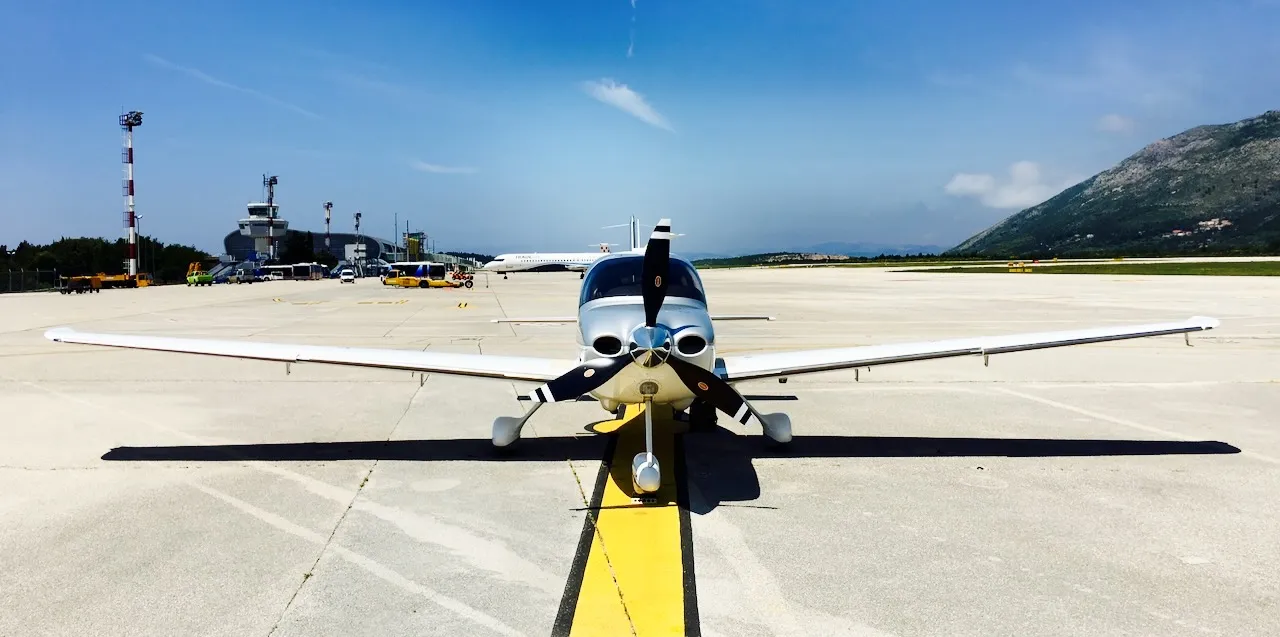
A comprehensive procedures reference for the Cirrus SR22TN covering all phases of flight - from takeoff briefing through cruise, approach, landing, and emergencies.
Important Speeds
| Speed | Value |
|---|---|
| Vne | 200 KIAS |
| Vno (Max structural cruising) | 177 KIAS |
| Va (Maneuvering Speed) | 133 KIAS |
| Vfe 50% | 119 KIAS |
| Vfe 100% | 104 KIAS |
| Vy (Best rate of climb) | 101 KIAS |
| Vx (Best angle of climb) | 84 KIAS |
| Best glide | 88 KIAS |
| Cruise climb <7,500 MSL | 120 KIAS |
| Cruise climb >7,500 MSL | 130 KIAS |
- Do not reduce manifold pressure below 15” above 18,000 ft
- Banks >60° prohibited
- ALT 2 required for IFR, working flashlight required for night ops
Takeoff Briefing Template
RWY __, normal take-off, ____m RWY length, wind xxx/yy Rotate at 72 kt, flaps up 85 kt w/ positive climb rate, 101 kt initial climb speed, (CAPS alive 500 ft) Pattern altitude ___ft DEP ___, to ___, TURN, CLIMB, Class C above
Emergency Brief
- Prior to take-off → abort
- 0–500 ft → land straight ahead (no more than 15° bank)
- 500–2,000 ft → CAPS immediately
- Above 2,000 ft → troubleshoot, consider CAPS
Takeoff
- Set T/O power smoothly, rudder right, no brakes, aileron into wind
- TAKE OFF → AIRSPEED ALIVE (60 kt) → ROTATE (70–73 KIAS) → FLAPS UP (80 KIAS + positive climb rate)
- 1,000 ft AGL: cruise climb speed 120–130 KIAS
- Mixture full rich during full power climb up to 15,000 ft
- Lean of Peak climb: Power lever FULL FORWARD, Cyan target or less, 130 KIAS
Passenger Briefing
- CAPS, seat belts, emergency exits, safety equipment, smoking, oxygen
Climb
- Keep CHT in normal operating temperatures (<380°F)
- After transitioning to cruise: throttle 2700, lean to blue caret, CHTs below 380°F
- Above 18,000 MSL: full power / full mixture climb
LOP (Lean of Peak) Operations
LOP Climb
- Full power, then smartly pull back mixture to below 18 GPH (book recommends 17.6)
- Don’t hesitate - passing “danger territory”
- Throttle remains full forward
- Only with airspeeds above 130 KIAS for cooling
- If CHTs approach 380°F, lower nose; if insufficient, go full rich
- Above FL180: full rich only
High Cruise
- Throttle until MP decreases but RPM stable at 2500
- Open throttle again until it just doesn’t increase RPM from 2500 = Max MP at 2500
- Mixture to 17.6 GPH
- Keep CHTs below 380°F - when LOP, leaner = cooler
Economy Cruise (65%)
- 24–26” MP, 13–15 GPH (13.6 GPH = 65%)
Descent
- Leave everything at cruise setting unless too fast → reduce to 65%
- If still too fast, leave mixture, reduce throttle further
- Avoid power idle, maintain CHTs >240°F
Summary: Only 4 Power Settings Needed
| # | Setting | Use |
|---|---|---|
| 1 | Full power, full rich | Takeoff / climb |
| 2 | Full power, LOP 17.6 GPH | LOP climb |
| 3 | Max MP at 2500 RPM, 17.6 GPH | High cruise |
| 4 | 24–26” MP, 13–15 GPH | Economy cruise |
Cruise Flow
- Fuel pump (off after 30 min, note fuel flow, readjust mixture)
- Power lever
- Mixture
- Engine parameters
- Fuel flow and balance
Traffic Pattern
| Phase | Speed | Power | Config |
|---|---|---|---|
| Downwind | 100 KIAS | 50% / 15” MP | - |
| Abeam (touchdown point, initiate descent) | 100 KIAS | 25% | 50% flaps |
| Base | 90 KIAS | 25% / 12” MP | 100% flaps |
| Final | 80 KIAS | as required | 100% flaps |
- 85 KIAS at 50% flaps, 90 KIAS at 0% flaps
- For each 10 kt crosswind, add 5 kt on final
- 500 ft announcement at turn to final (= 1 mile final)
Landing
- Stable VFR approach at 500 ft AGL: correct config, normal angle/rate, proper airspeed, appropriate power, correct flight path
- Flare: smoothly pull back power and pitch (never directly to idle) → view from higher when pitching up
- Aerodynamic braking by pulling pitch full back
- Crosswind: 100% flaps + crab, transition to wing-low method, touch down with slight bank to wind, aileron to wind during roll-out
Go Around
- Autopilot DISENGAGE
- Power FULL FORWARD (right rudder)
- Flaps 50%
- Pitch up, 75–80 KIAS
- Say “Going around”
- Positive climb + clear of obstacles + 80 kt → Flaps 0%
Go around when: no stabilized approach, excessive ballooning/bouncing, loss of directional control, landing beyond first 1/3 of runway, any unsafe condition
Maneuvers
Steep Turns
- Set HDG bug, 120 KIAS, 55% PWR / 20” MP
- Bank 45°, increase back pressure + slight power
- Roll out 10° prior to final heading, release back pressure
Slow Flight
- Flaps 0% → 100%, reduce power 25% / 12” MP
- Decelerate to MCA, add power to maintain level
- Recovery: 100% PWR, reduce AoA, Flaps 100% → 50%, accelerate to Vy, Flaps 0%
Stalls (Flight Review)
- No-flaps, takeoff, and landing configuration
- At stall horn / buffet → Pitch – Power – Bank
Power-Off Accuracy Landing
- 2,000 ft, 88 kt best glide
Steep Turns (Flight Review)
- Set heading bug, pull back immediately when initiating
IFR Procedures
Precision Approach (ILS)
- Cleared to IAF: slow to 120 KIAS (40% PWR)
- Complete Descent + Approach Checklist
- Final intercept: complete Before Landing Checklist
- GS Alive → 100 KIAS, Flaps 50%, 50% PWR
- Glideslope intercept → time noted at IAF
- 1/2 scale below GS → 50% PWR
- FAF inbound → 25% PWR / 12” MP
- Altitude callouts: 1,000 ft, 500 ft, 100 ft to minimums
- At DA: AP disconnect OR missed approach
GPS Approach Types
- LPV - Localizer Performance with Vertical Navigation (SBAS)
- LNAV/VNAV - with vertical guidance
- LNAV - lateral only, minimum descent altitude
- LNAV+V - with advisory glidepath
VOR Approach
- Load VOR approach, activate DME arc if needed
- Switch CDI from GPS to VOR when approaching approach path
- Press APR to activate VOR approach
- 2 miles prior FAF: 50% flaps, 100 KIAS
Circling Approach
- NAV mode in final, level off at minimum
- Fly to runway visibility, break 45°
- 0.5 track distance error - turn back to runway heading
- Shortly after landing point, turn 25° angle and keep constant
RNAV Flight Plan Equipment Codes (N111DU)
- Field 10:
SBGRYD(Standard, LPV, GPS RNAV, 8.33 kHz, DME) - Field 18:
PBN/B2C2O2S1andNAV/SBAS - O2 (RNP1) preferred over D2 (RNAV1)
- Private operators: no special permits needed (confirmed by LBA)
Emergencies
Engine Failure in Flight
- Best glide 88 KIAS
- Mixture, Fuel selector SWITCH, Fuel pump BOOST, Alternate induction air ON
- Glide distance: 11 NM from 8,000 ft
Engine Fire During Start
- Mixture CUTOFF, Fuel pump OFF, Fuel selector OFF, Power lever FORWARD, Starter CRANK
Emergency Descent
- Power idle, Mixture, Airspeed Vne 200 KIAS
CAPS Activation
- Handle Cover REMOVE
- Handle (both hands) PULL STRAIGHT DOWN
| Altitude | Action |
|---|---|
| 0–500 ft | Land straight ahead |
| 500–2,000 ft | Deploy CAPS immediately |
| >2,000 ft | Troubleshoot, CAPS as required |
Related articles
Cirrus SR22TN Checklists & IFR Procedures
Custom checklists for the Cirrus SR22TN - VFR/IFR main checklist, approach procedures for precision and non-precision approaches, and a complete IFR flight planning checklist.
The Circling Approach - Finally Explained So It Actually Makes Sense
A step-by-step technique for flying the circling approach with confidence - the 45° break, 30-second rule, half-track-width correction, and constant-angle final turn. With Cirrus SR22T examples.
US West Coast Trip in a Cirrus SR22T G5
A flight report from a West Coast tour in a nearly new Cirrus SR22T G5 - from San Carlos to Las Vegas, Sedona, San Diego, Santa Monica, and over the Golden Gate Bridge at 1,000 ft.