AI Product and Tech Resources
A curated collection of the most important AI tools, frameworks, and resources for product and tech leaders - updated for the agentic era.
On this page
Collection of my most important AI resources for product and tech, updated for 2026.
Agentic Development Tools
The tools that have fundamentally changed how I build software:
- Claude Code - Anthropic’s CLI-based agentic coding tool. My primary development tool. Uses Claude Opus 4 to autonomously read codebases, implement features across multiple files, run tests, fix errors, and commit code. The CLAUDE.md specification pattern makes it remarkably effective. Best with the Max subscription.
- Cursor - AI-native IDE built on VS Code. Agent mode handles multi-file edits autonomously. Excellent model selection (Claude, GPT-4o, Gemini). My go-to for visual code review and parallel workstreams alongside Claude Code.
- Windsurf - Codeium’s agentic IDE with “Cascade” - a multi-step agent that plans and executes across your codebase. Strong alternative to Cursor with good flow state UX.
- Cline - Open-source agentic coding extension for VS Code. Supports multiple model backends (Claude, GPT, local models via Ollama). Great option if you want agent capabilities with model flexibility.
- Aider - CLI-based agentic coding tool with excellent git integration. Supports pair programming with multiple models. Good for developers who prefer terminal workflows.
- Continue.dev - Open-source AI coding assistant with flexible model routing. Supports local models, cloud APIs, and custom backends. Good for teams wanting control over their AI tooling.
AI Model Providers and Routers
- OpenRouter - Unified API for accessing 200+ models from all major providers. Pay-per-token pricing, automatic fallbacks, and model comparison. Essential for testing different models against your use cases.
- Anthropic API - Direct API access to Claude models. Best-in-class for tool use, structured outputs, and agentic workflows. The MCP (Model Context Protocol) ecosystem is growing fast.
- OpenAI API - GPT-5, o1/o3 reasoning models, DALL-E, Whisper. Still the most widely integrated API.
- Google AI Studio / Vertex AI - Gemini 2.5 Pro/Flash. The 1M+ token context window is unmatched for large document processing.
Local LLM Tools
Running models on your own hardware - essential for privacy, speed, and cost:
- Ollama - The simplest way to run local models.
ollama run qwen3-coderand you’re up. Great model library, easy API, works with most AI tools. - MLX - Apple’s machine learning framework optimized for Apple Silicon. The mlx-community on Hugging Face provides pre-converted model weights. Best performance on Mac hardware.
- LM Studio - GUI application for running local models. User-friendly model discovery and management. Good for non-terminal users.
- llama.cpp - The foundational C/C++ inference engine that made local LLMs possible. GGUF format is the standard for quantized model distribution.
MCP (Model Context Protocol)
The emerging standard for connecting AI models to external tools and data:
- MCP Specification - Anthropic’s open protocol. Rapidly becoming the standard for tool integration.
- MCP Servers Registry - Growing collection of pre-built MCP servers for common integrations (GitHub, Slack, databases, file systems, APIs).
AI Infrastructure and Frameworks
- LangChain / LangGraph - Framework for building LLM applications. LangGraph is the more interesting piece now - it handles stateful, multi-step agent workflows.
- Vercel AI SDK - Excellent SDK for building AI-powered web applications. Streaming, tool use, and multi-provider support out of the box.
- Instructor - Library for structured output extraction from LLMs. Works with multiple providers. Essential for production AI features that need reliable data formats.
- Pydantic AI - Type-safe AI agent framework from the Pydantic team. Clean, Pythonic approach to building agentic systems.
Vector Databases for RAG
- Pinecone - Managed vector database. Easy to start, scales well.
- Weaviate - Open-source vector database with hybrid search.
- pgvector - PostgreSQL extension for vector similarity search. Often the right choice if you’re already on Postgres - no new infrastructure needed.
Essential Reading
Articles and Posts
- The Bitter Lesson - Rich Sutton’s foundational essay on why scaling wins
- Situational Awareness - Leopold Aschenbrenner’s influential analysis of AI trajectory
- AI-enhanced development - Simon Willison on practical AI-assisted development
- The end of programming as we know it - O’Reilly on the transformation of software development
- Anthropic Research Blog - Deep dives into AI safety, capabilities, and system design
- Simon Willison’s Weblog - The single best source for practical AI engineering insights
Books
- AI Engineering by Chip Huyen (O’Reilly) - The definitive guide to building with foundation models
- Designing Machine Learning Systems by Chip Huyen - Still relevant for ML Ops fundamentals
AI Engineering Landscape
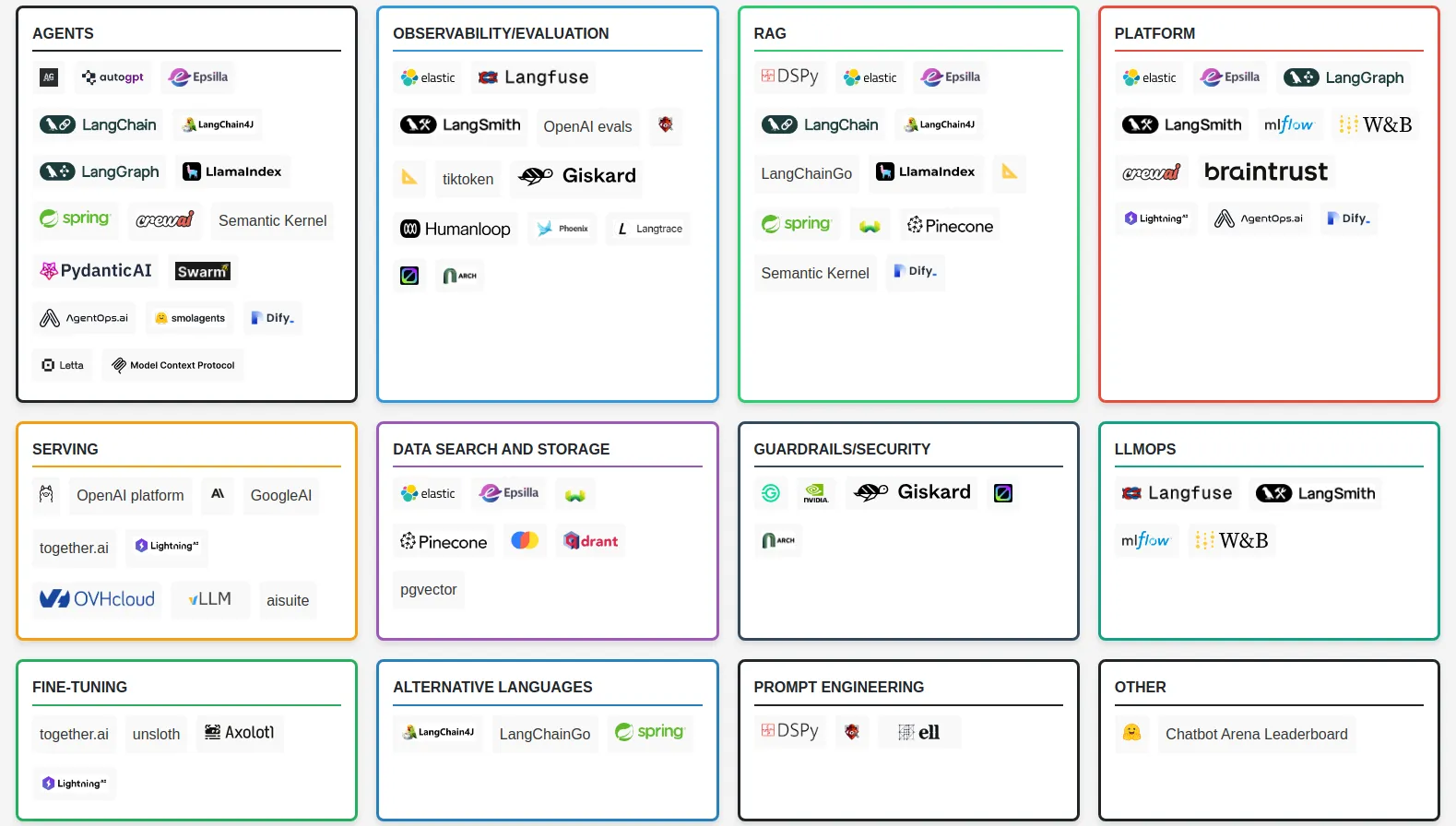
For a comprehensive visual overview of the AI engineering ecosystem, the AI Engineering Landscape remains an excellent resource, though it’s worth noting the landscape shifts quarterly at this point.
Related articles
AI-Driven Development - Agentic Coding in 2026
How agentic AI has transformed software development - from pair programming to autonomous coding agents, overnight agent factories, and vibe coding.
Agentic Development Patterns - Building Software with AI Agents
Practical patterns and workflows for agentic software development using Claude Code, Cursor, and local LLMs - from parallel workstreams to overnight agent factories.
The Overnight Agent Factory - Autonomous Development with Claude Code & Cursor
How I run parallel AI agents overnight to build production software while I sleep.